


Knight's Tournaments
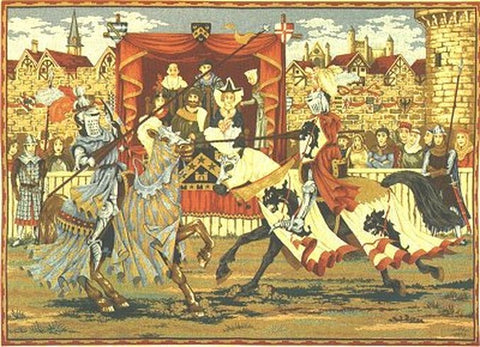
The Thrill of Tournaments: Where Coats of Arms Became Essential
When we picture medieval knights, it’s hard not to imagine shining armor, lances lowered, and the thunder of hooves in a joust. But behind that image is a fascinating story: tournaments weren’t just entertainment—they were training grounds, social spectacles, and the reason coats of arms became so important.
The Birth of the Tournament
Tournaments are said to have been invented in 11th-century France by Godfrey de Preuilly. What began as practical training for knights quickly turned into something much larger: part sport, part spectacle, and part career-making opportunity. Think of it as the medieval version of professional sports, where a knight could win not only glory but also riches—or even the hand of a noblewoman.
A tournament wasn’t a single fight, but a series of mounted and armored contests. Dozens of knights might enter, but only one emerged the victor, rewarded with money, status, or sometimes a life-changing prize.
Pageantry, Prestige, and the Rise of Coats of Arms
By the 14th century, tournaments had become grand public events, filled with pomp and ceremony that drew crowds from across the land. Knights needed a coat of arms not only to identify themselves in the chaos of combat but also to gain entry to the competition at all. Heraldry was their “team jersey,” a way of displaying family lineage, honor, and reputation.
Types of Tournaments
Not all tournaments looked the same. Different formats tested knights in unique ways:
-
The Joust – The most famous event, where two knights faced off with lances. Sometimes it was a one-on-one duel, but larger tournaments (called jousts à plaisance) stretched over several days with elimination rounds until one champion stood tall. Each knight usually got three passes against his opponent before elimination.
-
The Pas d’Armes (Passage of Arms) – A knight would issue a bold public challenge, declaring that he would take on all comers at a set time and place. It was both a test of skill and a dramatic display of confidence.
-
The Melee – These were large-scale team battles, designed to simulate real warfare. They could take place on foot (mêlée à pied) or on horseback (mêlée à cheval), with groups of knights clashing in a chaotic but thrilling spectacle.
More Than Just Sport
Tournaments were more than competitions—they were showcases of knightly culture. They combined military training, entertainment, and social climbing, and they helped cement the role of coats of arms as essential symbols of identity and honor in medieval society.


